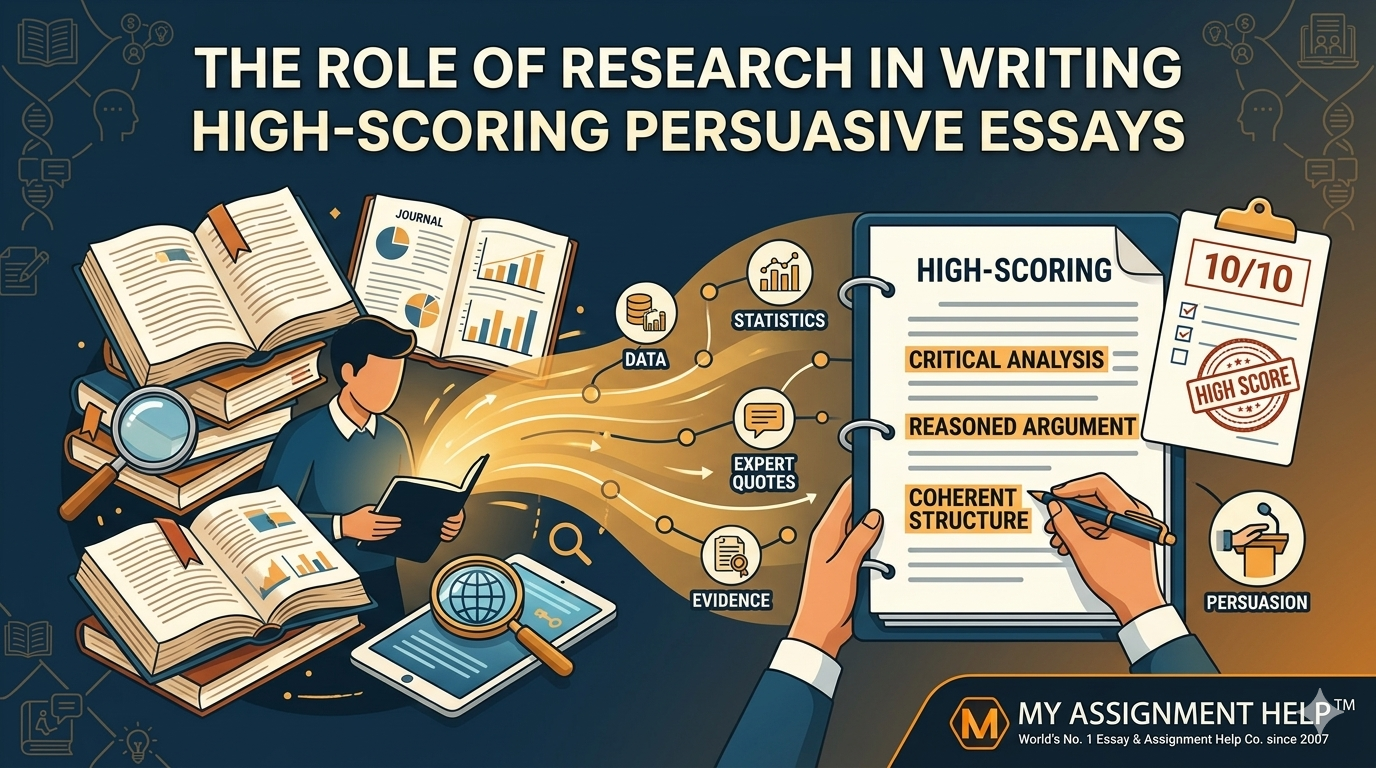
Persuasive writing is often misunderstood as an exercise in pure eloquence. Many students believe that a passionate voice, a dramatic tone, and a handful of rhetorical flourishes are enough to sway an audience and secure an A-grade. However, in contemporary academic environments, raw emotion without empirical backing falls flat. The true backbone of any compelling argument is rigorous, methodical research.
In higher education, evaluating a persuasive essay goes beyond assessing grammar or style; grading rubrics heavily emphasize critical thinking, evidence-based reasoning, and intellectual integrity. Without deeply researched evidence, a persuasive essay degrades into a mere opinion piece. This comprehensive guide explores why research is the ultimate differentiator in persuasive writing, how to strategically gather high-value evidence, and how to synthesize data to construct bulletproof academic arguments.
1. Why Research is the Foundation of Persuasion
To persuade someone is to alter their perspective or compel them to take a specific action. In academic discourse, your reader is typically a professor or a scholar—an individual trained to spot cognitive biases, logical fallacies, and unsubstantiated claims. Research transforms a subjective claim into an objective, verifiable reality.
Establishing Academic Authority (Ethos)
According to the classical Aristotelian modes of rhetoric, ethos represents the speaker’s authority and credibility. When you inject high-quality, peer-reviewed data into your paper, you borrow the authority of established experts. Instead of asking the grader to trust your personal opinion, you are demonstrating that your stance aligns with verified empirical realities.
Neutralizing Counterarguments
An excellent persuasive essay does not ignore the opposing view; it systematically dismantles it. You cannot successfully counter an adversarial perspective unless you understand its nuances. Comprehensive background research exposes the strengths and vulnerabilities of counter-opinions, allowing you to construct preemptive refutations that make your core thesis virtually unassailable.
2. Navigating the Data-Driven Academic Landscape
Modern academic standards place immense weight on data literacy. According to multi-institutional studies on undergraduate writing standards, over 75% of high-scoring rubrics in the humanities and social sciences prioritize a student’s ability to evaluate and apply evidence from systematic investigation.
When assignments demand rigorous investigation under tight deadlines, students often seek structural assistance to organize their drafts efficiently. Utilizing professional resources allows writers to study exemplary structural layouts and evidence integration. For instance, many students choose to buy persuasive essay solutions from specialized academic platforms to analyze how seasoned content strategists blend empirical data with rhetorical devices seamlessly without disrupting the natural reading flow.
Moreover, the digital transformation of education has introduced automated brainstorming tools to the mainstream. While over-reliance on automation can dilute a paper’s authentic voice, using an advanced, algorithmically driven ai essay typer can act as an excellent starting point for outlining arguments. Platforms like myassignmenthelp provide these technical frameworks to help students visualize their essay’s macro-structure, which they can subsequently enrich with primary and secondary research.
3. The Anatomy of Academic Evidence: What Counts?
Not all data is created equal. To fulfill the strict criteria of search engine standards like E-E-A-T (Experience, Expertise, Authoritativeness, and Trustworthiness)—which mirror academic grading standards—you must categorize and select your sources with extreme care.
Key Academic Source Types
- Peer-Reviewed Journals: The gold standard of academic value. Best used for providing foundational theories, experimental data, and consensus views.
- Government White Papers (.gov): High value. Ideal for extracting macro-demographics, legislative data, and official economic statistics.
- Academic Think Tanks (.org): High to medium value. Best for sourcing specialized policy analyses, sociological trends, and global indices.
- Mainstream News Media: Medium value. Useful for establishing real-world relevance, timelines, and current cultural context.
The Currency of Information
In rapidly evolving fields such as cybersecurity, macroeconomics, or public health, the age of your data matters significantly. As a rule of thumb, ensure that at least 70% of your literature matrix consists of sources published within the last three to five years. Citing outdated metrics signals to an evaluator that your literature review was superficial.
4. The Logic-to-Landscape Blueprint: Linking Data to Rhetoric
Integrating data into a persuasive essay is an art form. Simply dropping a statistic into the middle of a paragraph without context creates a jarring reading experience. Academic writers utilize the “Claim-Evidence-Elaboration” (CEE) framework to weave research into their prose organically.
- Claim: State your persuasive assertion clearly.
- Evidence: Introduce verified data or a citation from a reputable source.
- Elaboration: Explain exactly how the data proves your claim.
The Four Phases of Research Processing
- Discovery: Identify academic consensus via major academic databases.
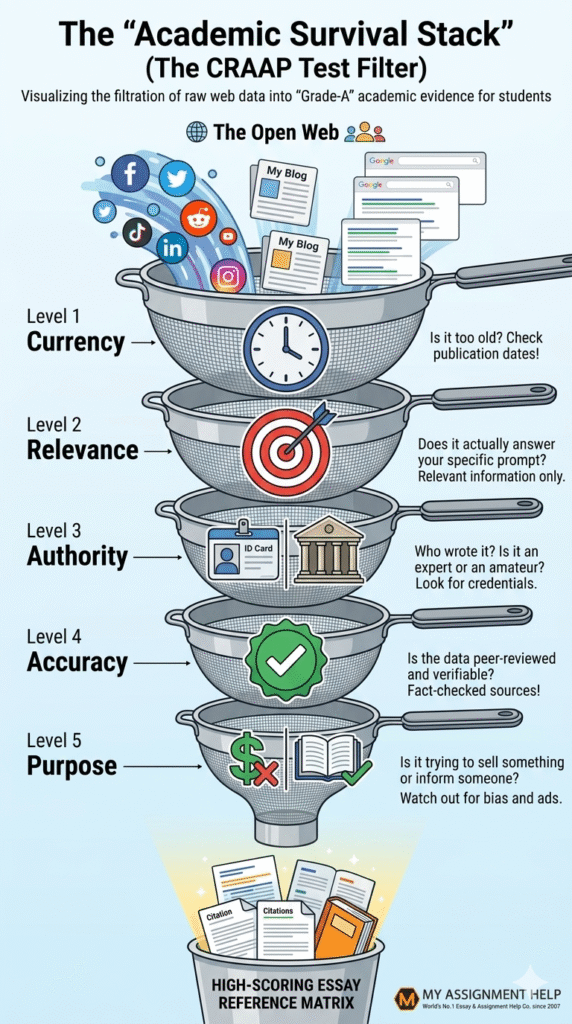
- Filtration: Isolate variables, verify methodologies, and cull out biased or commercialized datasets.
- Contextualization: Synthesize using the CEE Framework to avoid dropped quotes.
- The Persuasive Payoff: Achieve a high-scoring essay built on undeniable empirical realities rather than speculative opinions.
5. Step-by-Step Research Strategy for High-Scoring Essays
To maximize efficiency and eliminate academic anxiety, follow this structured, five-step research process:
- Step 1: Deconstruct the Prompt — Before opening a search engine, identify the core field directives (such as analyze, evaluate, or contrast) and scope limiters like historical eras, geographical boundaries, or specific demographics.
- Step 2: Formulate Smart Search Queries — Do not type full questions into academic databases. Instead, leverage target keyword combinations and filters to isolate hyper-relevant academic literature.
- Step 3: Execute a Lateral Source Check — When you find an exceptional journal article, review its bibliography. Tracking down the references cited by an expert is one of the fastest ways to build a robust, interconnected literature matrix.
- Step 4: Evaluate with the CRAAP Test — Subject every potential source to five distinct criteria: Currency (timeliness), Relevance (importance to your needs), Authority (author credentials and institutional backing), Accuracy (reliability and truthfulness), and Purpose (the reason the information exists).
- Step 5: Outline with Data Placeholders — Draft your structural outline with clear annotations indicating exactly where specific datasets, percentages, and expert quotes will be integrated to support your topic sentences.
Key Takeaways
- Research Over Rhetoric: True persuasion relies on empirical facts, peer-reviewed studies, and verifiable data rather than pure emotional or stylistic writing.
- Strategic Sourcing: Utilize authoritative databases like Google Scholar, JSTOR, and government repositories (.gov) to build a credible literature matrix.
- Ethos and Credibility: Aligning your essay’s claims with data from recognized institutional experts establishes strong academic authority.
- Seamless Integration: Use the Claim-Evidence-Elaboration (CEE) method to weave stats smoothly into your paragraphs without disrupting readability.
- Ethical Scaffolding: Advanced digital tools are valuable for macro-structural outlining, but deep, personalized research is required to ensure an original, plagiarism-free final draft.
See also: Why Criminology in Education Matters for Today’s Students
Frequently Asked Questions (FAQs)
1. How many sources do I need for a 1,500-word persuasive essay?
As an academic standard, a high-scoring 1,500-word essay typically requires between 8 to 12 high-quality references. This range ensures that every major claim you make is backed by independent research without oversaturating your original voice.
2. Can a persuasive essay rely entirely on emotional arguments?
No. While emotional appeals can make a paper more engaging, they must be subordinate to logical arguments and ethical credibility. An essay built exclusively on emotion will fail to withstand academic scrutiny or grading rubrics.
3. How do I cite my research without disrupting the flow of my writing?
Utilize parenthetical or narrative in-text citations depending on your required formatting style (APA, MLA, Harvard, or Chicago). Integrate authors organically into your sentences—for example: “According to data compiled by Smith, urban infrastructure trends indicate…”
4. What is the difference between an analytical essay and a persuasive essay?
An analytical essay breaks down a complex issue into components to examine its structure and meaning objectively. A persuasive essay takes a definitive stance on an issue and actively uses researched evidence to convince the reader to accept that specific viewpoint.
5. How can I ensure my data-driven essay remains completely plagiarism-free?
Always paraphrase the original author’s ideas in your own unique sentence structures and vocabulary, and provide a precise citation for the source. When using exact phrasing, place the text in quotation marks accompanied by a page or paragraph number.
Author Biography
Dr. Evelyn Vance
Senior Academic Research Strategist & Senior Content Writer at MyAssignmentHelp
Dr. Evelyn Vance holds a Ph.D. in Rhetoric and Composition, specializing in contemporary argumentative structures and digital literacy framework design. With over nine years of experience in higher education instruction and curriculum development, Dr. Vance currently serves as a senior content advisor and chief academic strategist at MyAssignmentHelp. Her work focuses on assisting international students across the US, UK, and Australia in mastering advanced research synthesis, eliminating academic writing anxieties, and executing highly polished, evidence-driven essays that strictly align with institutional assessment standards.